Why are some products cheap, and others you cannot afford? Why is there a discount when new devices are launched? In the end, this all comes down to markets and people paying for things — a fundamental idea in economics that harmonizes resource allocation.
Dear Readers, welcome back to yet another compelling exploration of the economics world at Economists Inn. In this effort, we explore a more basic idea that is fundamental to the functioning of markets — i.e., price mechanism and its imperative in resource allocation. So, go get your beverage of choice, sit in that comfy chair, and enjoy a little dive into this interesting topic with me.
What is the Price Mechanism?
The major economic system, known as the price mechanism or market system, determines the creation of goods and services by addressing the following questions: What commodities are manufactured? Who consumes them? How are they produced? This system optimizes resource utilization, ensuring that costly materials are employed only where they add the most value.
Supply and Demand Dynamics
Price mechanism, as we know, comes straight from the basics of supply and demand. And whenever there is an increase in demand and constant supply, prices usually go up. This results in a fall of prices if instead the supply is increased with an unchanged demand. It’s also what allows resources to be distributed efficiently and effectively (supply flows where demand is).
Price Signals
Prices provide signal to both consumers and producers. A high price is an indication of high demand or low supply that calls for expansion by producers and welcoming the entry of new players to augment current provisions. Conversely, a low price means that there is too much supply or not enough demand, so producers will be more reluctant to produce. Driven by prices, consumers choose what to buy and how much of it given their wants versus the constraints on their incomes.
Incentive Function
Prices provide incentives for economic agents. Higher prices lead production to increase because the producers can make more profit and correlate less waste outputs. Conversely, the lower prices will motivate consumers to buy more. For example, the discounted prices prevailing during a period of sale urge expensive materials to be sold that not everyone would buy willingly.
How the Price Mechanism Allocates Resources
The allocation of resources is a critical function in any economy. The price mechanism plays a vital role in this process by determining how resources are distributed across different uses. Here’s how it works:
Efficient Resource Allocation
Prices ensure that resources are allocated efficiently. High prices for certain goods or services signal producers to increase production, drawing resources from less valued uses. This reallocation boosts overall economic efficiency by directing resources to their most productive uses.
Consumer Sovereignty
In a market-driven economy, consumer preferences dictate what is produced. When consumers favor certain goods, their willingness to pay higher prices directs resources towards these products. This phenomenon, known as consumer sovereignty, underscores the power of individual choices in shaping the economy.
Case Studies: The Allocative Function of Price Mechanism
Now, let’s bring it all together and discuss how the price mechanism allocates resources in the economy. Imagine a world without prices — a chaotic, directionless mess. Prices help avoid this chaos by guiding resources to their most valued uses. To understand the price mechanism’s impact, let’s explore a few real-world examples:
The Tech Industry Boom
The rapid advancements in technology illustrate the price mechanism perfectly. When a new gadget hits the market, its high price reflects initial scarcity and high demand. As technology evolves and production costs decrease, prices fall, making these gadgets accessible to a broader audience. This cycle fuels continuous innovation and resource reallocation in the tech industry. Similarly, the higher prices of solar panels signal manufacturers to increase production, attracting more investment and resources into the renewable energy sector. Over time, the increased supply may lead to more affordable solar panels, benefiting consumers and promoting a cleaner environment.
Agricultural Markets
Agriculture provides a classic example of the price mechanism at work. Weather conditions, for instance, can drastically affect crop yields. A poor harvest leads to higher prices due to reduced supply, incentivizing farmers to plant more in the next season. Conversely, a bumper crop results in lower prices, signaling farmers to diversify or reduce planting. Consider another example, if there’s a surge in demand for organic produce, the prices of organic fruits and vegetables will rise. This price increase signals farmers to allocate more land and resources to organic farming. As more farmers enter the organic market, supply increases, eventually stabilizing prices. Resources like labor, land, and capital are thus reallocated from less demanded to more demanded agricultural activities.
The Invisible Hand: Adam Smith’s Legacy
The concept of the price mechanism is closely tied to Adam Smith’s idea of the “invisible hand.” In his seminal work, “The Wealth of Nations,” Smith argued that individuals pursuing their self-interest inadvertently contribute to economic well-being through the price mechanism. This “invisible hand” guides resources to their most efficient uses without central planning.
The Price Mechanism in Different Market Structures
The efficiency of the price mechanism can vary depending on the market structure:
- Perfect Competition: In perfectly competitive markets, the price mechanism works flawlessly. Prices reflect the true cost of production and consumer preferences, leading to optimal resource allocation.
- Monopolistic Competition and Oligopoly: Here, the price mechanism is less efficient. Firms have some price-setting power, leading to potential misallocation of resources.
- Monopoly: In a monopoly, the price mechanism is significantly distorted. A single firm controls the market, setting prices that maximize its profit, often at the expense of allocative efficiency.
Market Failures and the Limitations of the Price Mechanism
While the price mechanism is powerful, it is not without limitations. Market failures can occur, leading to inefficient resource allocation. Some common types of market failures include:
- Externalities: When the production or consumption of a good affects third parties not directly involved in the transaction (e.g., pollution).
- Public Goods: Goods that are non-excludable and non-rivalrous, such as national defense or public parks, which the market may underprovide.
- Information Asymmetry: When one party has more or better information than the other, leading to adverse selection or moral hazard.
In such cases, government intervention may be necessary to correct these failures and ensure resources are allocated more efficiently.
Criticisms and Limitations
While the price mechanism is a powerful tool, it’s not without its flaws:
Market Failures
Market failures occur when the price mechanism fails to allocate resources efficiently. Common examples include public goods, externalities, and information asymmetries. In such cases, government intervention is often necessary to correct these inefficiencies.
Inequality
The price mechanism can exacerbate inequality. Those with higher incomes can afford more goods and services, while those with lower incomes may struggle. This disparity highlights the need for policies that address income inequality and ensure a fair distribution of resources.
Conclusion: Wrapping It Up
The price mechanism is a cornerstone of economic theory and practice, playing a crucial role in resource allocation. By balancing supply and demand, it ensures that resources are used efficiently, driving economic growth and innovation. However, its limitations and potential for inequality highlight the need for thoughtful economic policies to complement its function. Understanding this mechanism provides valuable insights into the forces shaping our economy and our daily lives.
The price mechanism is the unsung hero of the market economy, quietly working behind the scenes to ensure resources are allocated efficiently. By signaling where resources are needed and providing incentives to allocate them accordingly, prices help maintain the delicate balance of supply and demand.
So, next time you buy a cup of coffee, marvel at your smartphone, or enjoy a fresh salad, take a moment to appreciate the intricate dance of the price mechanism. It’s the silent force that keeps our economy ticking, one price signal at a time.
FAQs
What is the primary function of the price mechanism? The primary function of the price mechanism is to allocate resources efficiently by balancing supply and demand through price adjustments.
How do prices act as signals in the market? Prices signal producers to adjust supply based on demand and indicate to consumers how much they should buy, guiding economic decisions.
Can the price mechanism fail? Yes, the price mechanism can fail in cases of market failures, such as externalities, public goods, and information asymmetries, requiring government intervention.
How does the price mechanism influence innovation? High prices for new products signal strong demand, encouraging firms to innovate and improve production processes to lower costs and prices over time.
The preceding section aimed to distill complex economic concepts for non-economists. Now, let’s delve deeper into the technical intricacies with a rich blend of statistics, charts, and mathematical equations. This segment serves as the proverbial icing on the cake, catering to readers keen on exploring the quantitative underpinnings and empirical foundations of the subject matter.
Elaboration of Price Mechanism Using Diagram
Let’s create a diagram that illustrates the role of the price mechanism in resource allocation. This will include key components like supply, demand, equilibrium price, and the allocation of resources based on these factors.
Here’s a step-by-step plan for the diagram:
- Supply and Demand Curves: Show how they intersect to determine the equilibrium price.
- Equilibrium Point: Indicate where the supply and demand curves intersect.
- Resource Allocation: Explain how the equilibrium price influences the allocation of resources.
- Adjustments: Show how changes in supply and demand affect the equilibrium and resource allocation.
I’ll create a visual representation of this concept.

The above diagram is depicting the role of the price mechanism in resource allocation:
- Supply and Demand Curves: The blue line represents the demand curve, showing that as the price decreases, the quantity demanded increases. The red line represents the supply curve, indicating that as the price increases, the quantity supplied increases.
- Equilibrium Point: The point where the supply and demand curves intersect is the equilibrium point. Here, the equilibrium price is $3, and the equilibrium quantity is 2 units.
- Resource Allocation: At the equilibrium price, the quantity of goods supplied equals the quantity of goods demanded, efficiently allocating resources.
- Adjustments: If the demand or supply changes, the curves will shift, leading to a new equilibrium price and quantity, thereby reallocating resources accordingly.
This visual helps explain how the price mechanism coordinates supply and demand to allocate resources in an economy.
The following is the enhanced diagram depicting the role of the price mechanism in resource allocation, including adjustments due to shifts in supply and demand:
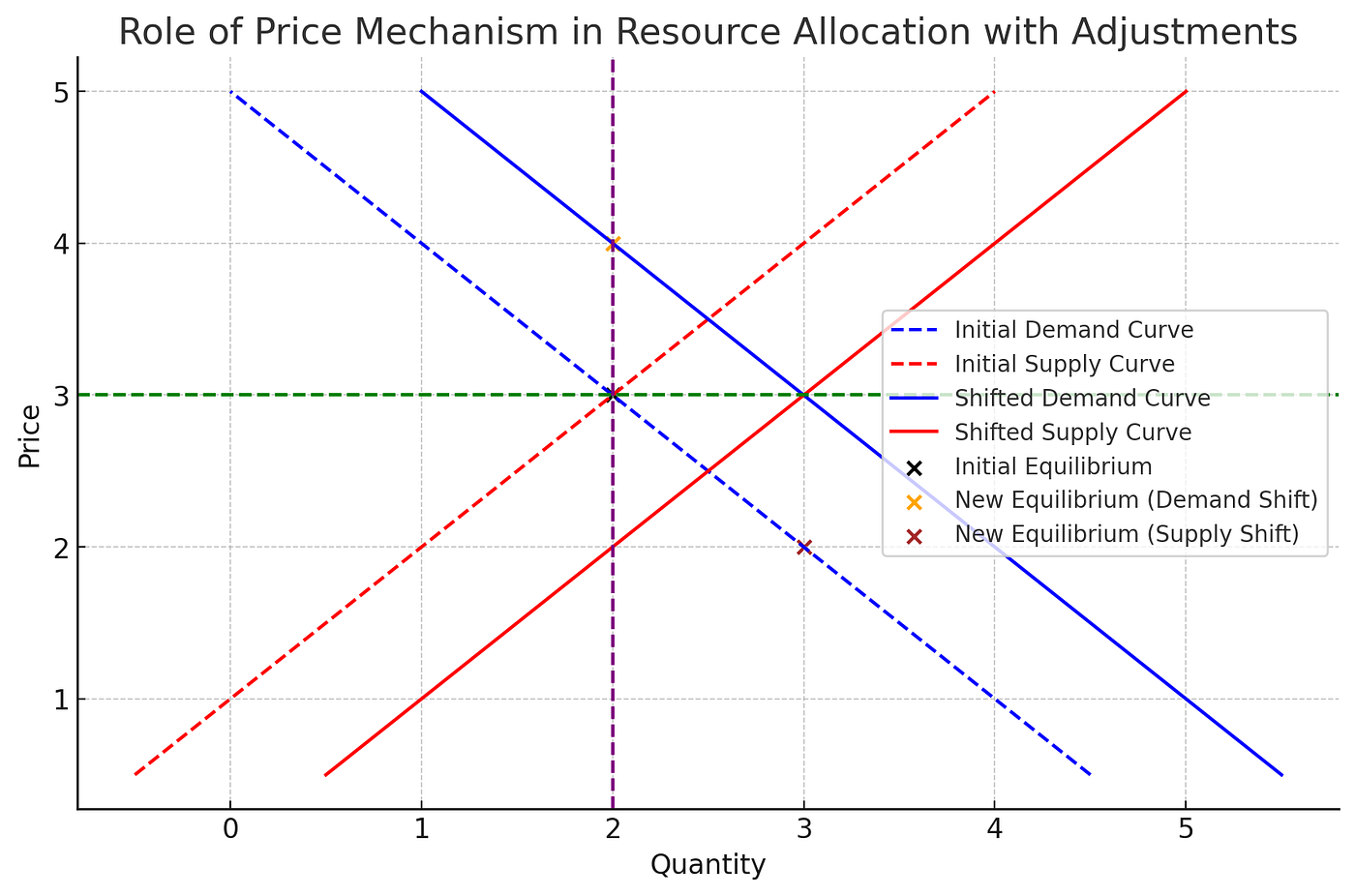
- Initial Supply and Demand Curves: The dashed blue and red lines represent the initial demand and supply curves, respectively. The initial equilibrium point, where these curves intersect, is shown with a black dot at a price of $3 and quantity of 2 units.
- Shift in Demand Curve: The solid blue line represents the shifted demand curve, indicating an increase in demand. This shift leads to a new equilibrium point (orange dot) with a higher price of $4 and the same quantity of 2 units.
- Shift in Supply Curve: The solid red line represents the shifted supply curve, indicating an increase in supply. This shift leads to another new equilibrium point (brown dot) with a lower price of $2 and a higher quantity of 3 units.
- New Equilibrium Points: The intersections of the new curves with each other and the initial curves show how changes in supply and demand result in new equilibrium prices and quantities, thereby reallocating resources in the market.
This diagram illustrates how the price mechanism responds to changes in market conditions to allocate resources efficiently.
Thank you for joining me on this exploration of the price mechanism and its role in resource allocation. If you enjoyed this post, be sure to share it with fellow economics enthusiasts and students. For more insights into the fascinating world of economics, stay tuned to Economists’ Inn, and as always, feel free to leave your thoughts and questions in the comments below!