From Barrels to Molecules: Why the GCC is Winning the Global Hydrogen Supremacy Race
By: Dr. Ghulam Mohey-ud-din
March 27, 2026
For nearly a century, the global economy has hummed to the rhythm of the “petrodollar.” But as I sit in Riyadh today, looking at the data for Q1 2026, it is clear that the rhythm is changing. We are no longer just witnessing an energy transition; we are witnessing a complete re-engineering of the Gulf’s value proposition.
The era of “Easy Oil” is being succeeded by the era of the “Zero-Carbon Molecule.” And while the West debates subsidies and the East scales manufacturing, the GCC is quietly building the world’s most formidable integrated green hydrogen ecosystem.
The New Economic Imperative: Survival via Decarbonization
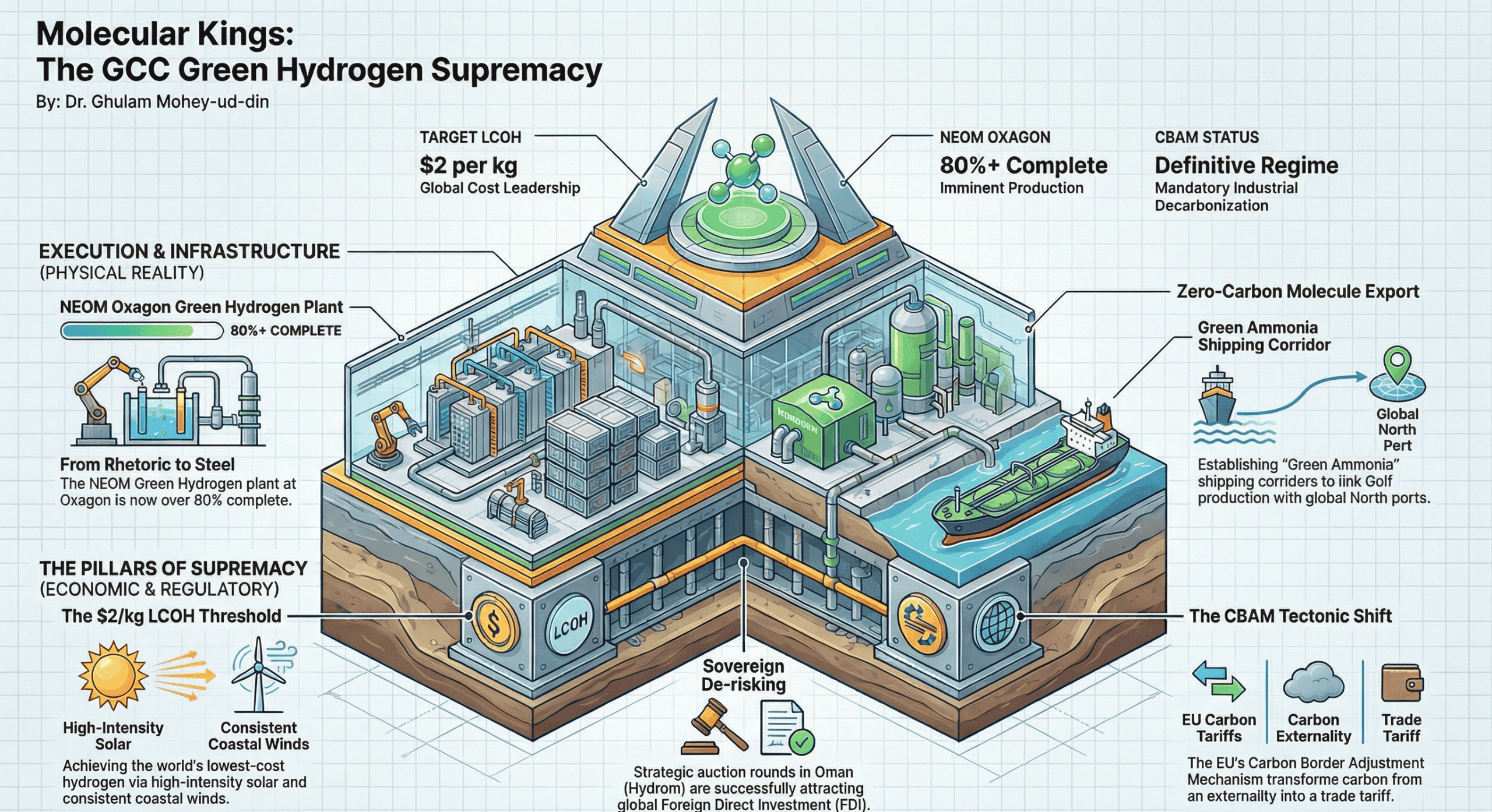
In my 30 years of advising finance ministries, I have rarely seen a regulatory “stick” as effective as the EU’s Carbon Border Adjustment Mechanism (CBAM). As of this year, CBAM has moved into its definitive regime. For the Gulf’s heavy industries—aluminum, steel, and fertilizers—carbon is no longer a footnote in a CSR report; it is a direct hit to the balance sheet.
The GCC’s pivot to green hydrogen is not merely a play for “green credentials.” It is a sophisticated defensive economic strategy. By integrating green hydrogen into domestic industrial clusters, the region is “future-proofing” its exports against global carbon tariffs. We are seeing the birth of “Decarbonization-as-a-Service,” where the Gulf provides the world with low-carbon products that the high-cost, land-constrained European industry simply cannot match.
The “Cost-Curve” Advantage: The Hunt for $2/kg
In economics, price is the ultimate truth-teller. The GCC possesses a unique “Natural Arbitrage”:
The Solar-Wind Hybrid: Unlike northern latitudes, the Gulf enjoys high-intensity solar irradiance by day and consistent coastal wind profiles by night. This maximizes the utilization rate of electrolyzers—the most expensive part of the hydrogen chain.
Sovereign De-risking: Through entities like Oman’s Hydrom and Saudi Arabia’s PIF, the public sector is absorbing the early-stage land and regulatory risks. This creates a “plug-and-play” environment for private developers that is virtually unmatched globally.
Our internal models suggest that with current efficiencies at NEOM’s Oxagon facility and the Port of Duqm, the Gulf is the only region on track to hit the $2/kg Levelized Cost of Hydrogen (LCOH) by 2027. At that price point, green hydrogen doesn’t just compete with “grey” (fossil-fuel based) hydrogen; it begins to disrupt the entire global chemical and maritime fuel industry.
The Fearless Advice: Three Risks No One is Talking About
As an advisor, my role is to look past the euphoria. While the trajectory is positive, three structural risks demand “intellectual stoicism” from decision-makers:
The Water-Energy Nexus: Hydrogen production requires ultra-pure water. If we rely solely on traditional desalination, we risk trading an energy crisis for a water crisis. The next wave of investment must focus on “Circular Water Economies”—using treated sewage effluent (TSE) or next-gen membrane technology.
Transport vs. Local Use: Moving hydrogen is expensive. The “liquefaction tax” is real. I am advising clients to prioritize “In-Situ Industrialization.” Don’t just export the hydrogen; use it to make green steel and green ammonia on-site. Export the value-added product, not just the raw molecule.
The Talent Bottleneck: We have the capital and the sun, but we are facing a global “Engineering Scarcity.” The race for green hydrogen is, at its core, a race for specialized human capital.
The Strategic Synthesis
The “Green Hydrogen Supremacy” is the Gulf’s way of ensuring it remains the “Central Bank of Energy” for the next century. By leveraging their fiscal strength today to build the infrastructure of tomorrow, the UAE, Saudi Arabia, and Oman are decoupling their prosperity from the volatility of Brent crude.
The “Middle Corridor” of trade is no longer just about shipping containers; it is about the pipelines and ammonia carriers that will link the sun-drenched plains of the Rub’ al Khali to the industrial heartlands of Germany and Japan.
Executive Summary for the C-Suite
| Pillar | Strategic Insight | Actionable Takeaway |
| Regulatory | CBAM is the new global trade barrier. | Audit your supply chain for “carbon-leakage” risks now. |
| Operational | LCOH is the only metric that matters. | Target $2/kg through hybrid renewable integration. |
| Geopolitical | Energy security is being redefined. | Position the GCC as the “Neutral Green Energy Hub.” |
Final Thought: In the 20th century, the world came to the Gulf for oil. In the 21st century, the world will come to the Gulf to solve the climate-math of their own industrial survival.