Key Terms: Indus Waters Treaty · Hydro-economic Security · Spatial Econometrics · Food Import Dependency · Glacial Flow Stress
Graphical Abstract: Summary
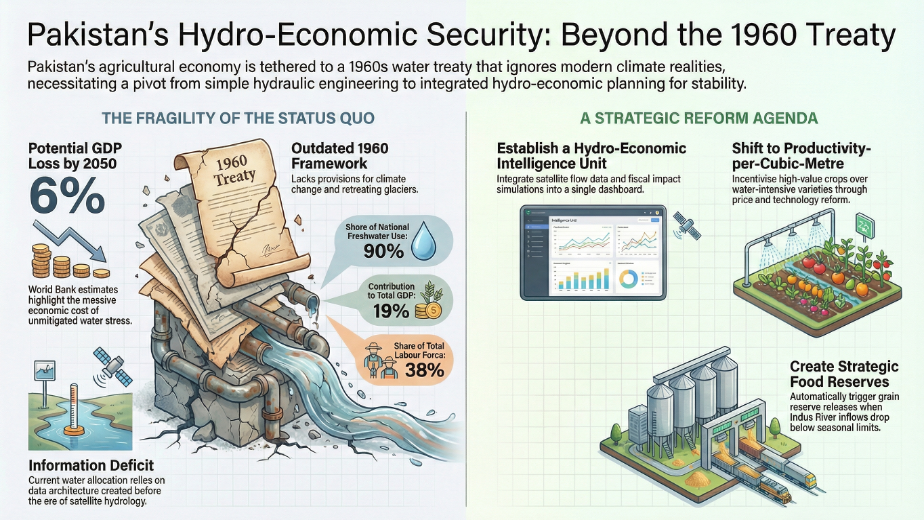
(Polciy Brief by Dr. Ghulam Mohey-ud-din)
Dr. Ghulam Mohey-ud-din
Abstract
Pakistan's agricultural economy — consuming over 90 percent of national freshwater and contributing approximately 19–23 percent of GDP — is governed by a water-sharing framework crafted in 1960 with no provisions for climate change or glacial retreat (World Bank, 2023a; United Nations Treaty Collection, 1960). India's expanding hydroelectric infrastructure on western rivers, compounded by accelerating Himalayan glacier loss, is transforming the Indus Waters Treaty from a diplomatic instrument into an active macroeconomic risk vector (ICIMOD, 2019). These brief diagnoses three structural failures — a hydro-economic integration deficit, a treaty governance gap, and entrenched market distortions — and advances five evidence-based reforms. The core argument: water governance is now the foundational variable upon which Pakistan's agricultural GDP, food sovereignty, and balance-of-payments stability depend.
Key Terms: Indus Waters Treaty · Hydro-economic Security · Spatial Econometrics · Food Import Dependency · Glacial Flow Stress
Graphical Abstract: Summary
Document
Suggested Citation
Mohey-ud-din, G. (2026). Indus Waters Under Stress: Hydro-economic Security in a Post-Treaty World. Policy Insights by Dr. Ghulam Maohey-ud-din, No. 002/2026.
Let's Work Together