Key Terms: Urban Productivity · Agglomeration Economies · Industrial Clustering · Structural Transformation · Export-Led Growth
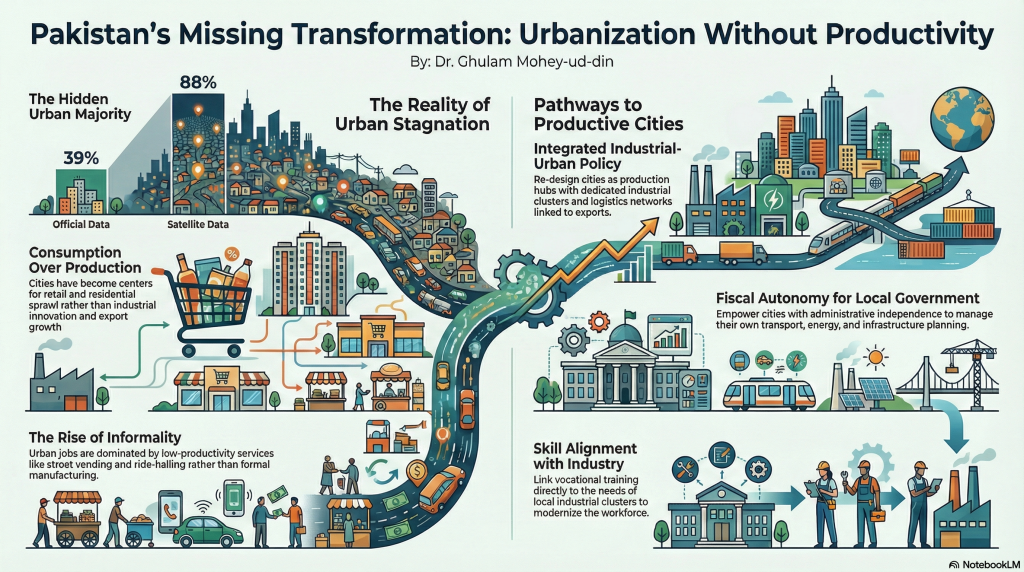
Graphical Abstract: Summary
Dr. Ghulam Mohey-ud-din
Abstract
Pakistan's urban population has expanded from approximately 33 percent in 2000 to 38–40 percent today, yet this demographic shift has not translated into the productivity gains historically associated with urbanization (World Bank, 2023). Cities have grown physically without deepening economically — absorbing labour into low-productivity informal services rather than export-oriented manufacturing. Over 70 percent of urban employment remains informal, constraining fiscal capacity and technological upgrading (Pakistan Bureau of Statistics, 2021). This brief identifies three structural gaps — a consumption-led growth model, fragmented metropolitan governance, and the absence of agglomeration economies — and advances five targeted reforms. The core argument: Pakistan's urban transition has occurred without industrial transformation, creating a cycle of informality, import dependency, and external vulnerability.
Key Terms: Urban Productivity · Agglomeration Economies · Industrial Clustering · Structural Transformation · Export-Led Growth
Graphical Abstract: Summary
Document
Suggested Citation
Dr. Ghulam Mohey-ud-din (2026). Urbanization without Productivity: Pakistan's Missing Structural Transformation. Pilcy Insights by Dr. Ghulam Mohey-ud-din, No. 001/2026.
Let's Work Together