The Two-City Trap: Industrial Concentration and the Case for Geographic Diversification in Pakistan
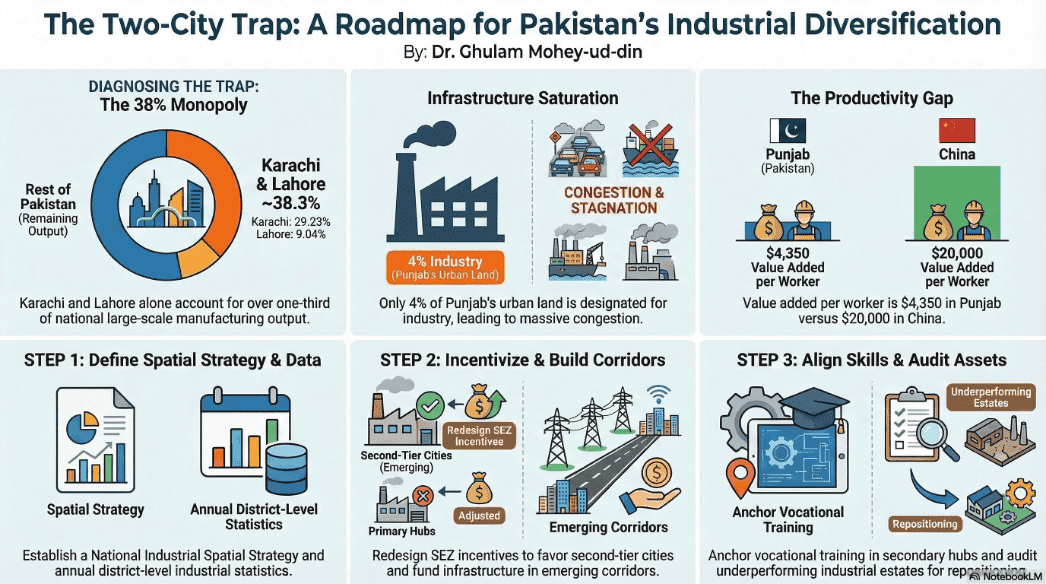
Pakistan’s large-scale manufacturing sector is not merely concentrated — it is captured by two cities. Karachi and Lahore together account for well over a third of national large-scale manufacturing (LSM) output, while the remaining 130-plus districts contribute only a marginal residual. This extreme geographic concentration is not the outcome of market efficiency or agglomeration economics operating at their best. It is the residue of decades of industrial policy neglect — a structural geography that now actively constrains Pakistan’s capacity for export-led growth, employment creation, and economic resilience.
Five Structural Failures Sustaining the Two-City Trap
This policy brief by Dr. Ghulam Mohey-ud-din identifies five converging structural failures that sustain industrial concentration and spatial inequality in Pakistan:
1. Absence of a National Spatial Policy Framework
Pakistan has no national industrial spatial strategy explicitly directing investment toward underserved districts. Industrial location decisions remain driven by incumbency effects and access to Karachi and Lahore infrastructure networks, with no counter-incentive pulling economic activity toward emerging corridors in Khyber Pakhtunkhwa, Balochistan, or southern Punjab.
2. Infrastructure Saturation in Primary Hubs
Both Karachi and Lahore are experiencing progressive infrastructure saturation — logistics bottlenecks, energy supply constraints, and urban congestion that raise the operating costs of new entrants while offering no productivity premium over second-tier alternatives. The marginal return on further infrastructure investment in primary hubs is declining.
3. District-Level Data Deficit
Industrial policy in Pakistan is effectively evidence-blind. The absence of reliable, disaggregated district-level data on industrial output, employment, productivity, and export performance means that reform decisions cannot be geographically targeted. Resource allocation follows administrative inertia rather than spatial economic evidence.
4. Industrial Cluster Lock-In and Stagnant Productivity
Existing industrial clusters in Karachi and Lahore exhibit lock-in rather than dynamism. Value added per worker in Punjab’s manufacturing sector stands at approximately USD 4,350 — compared to USD 20,000 in China — reflecting a productivity gap that spatial concentration has failed to resolve. The two-city trap does not deliver agglomeration benefits; it entrenches mid-productivity stagnation.
5. Skills Infrastructure Mismatch
Vocational and technical training infrastructure is concentrated in primary cities, creating a spatial mismatch between skills supply and potential industrial demand in emerging corridors. Districts with genuine comparative advantage in manufacturing — access to raw materials, lower land and labour costs, logistical connectivity — lack the human capital ecosystem to attract industrial investment.
The Reform Agenda: Six Targeted Policy Interventions
The reform agenda proposed in this brief is specific and sequenced, designed to break the industrial geography lock-in that the two-city trap represents:
Formulate a National Industrial Spatial Strategy with district-level growth targets and binding resource allocation parameters. Restructure SEZ incentive architecture to reward geographic dispersal rather than reinforcing concentration in existing industrial zones. Prioritise pre-competitive infrastructure investment in emerging industrial corridors — logistics connectivity, energy access, and digital infrastructure. Anchor skills ecosystem development in designated second-tier cities aligned with spatial industrial strategy. Establish an annual district-level industrial monitoring system to eliminate the data deficit that renders current policy evidence-blind. Audit and reposition Punjab’s underperforming industrial estate network, redirecting resources toward operationally viable, geographically distributed alternatives.
Why the Window Is Closing
The window for cost-effective geographic diversification of Pakistan’s industrial base is not permanent. As infrastructure saturation deepens in primary cities, as climate-related risks concentrate in coastal Karachi, and as fiscal constraints tighten the scope for public investment, the cost of redressing spatial inequality will rise. Pakistan’s two-city industrial trap is a structural constraint on the country’s growth trajectory — and dismantling it requires deliberate, evidence-based spatial policy intervention beginning now.
Policy Insights | Issue No. 04 | March 2026 | Industrial Geography | Dr. Ghulam Mohey-ud-din, Senior Economist & Policy Advisor