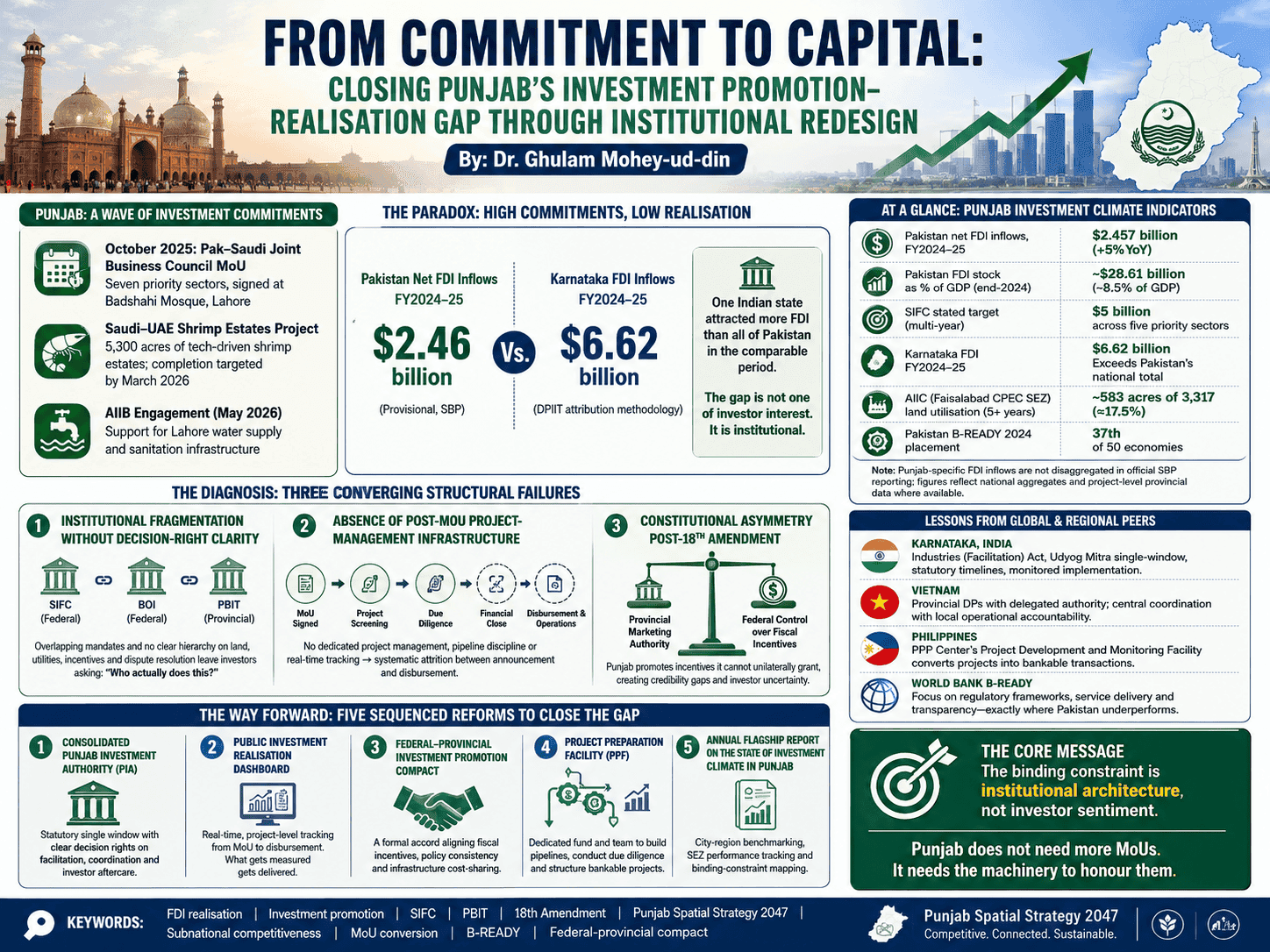
Punjab (for Punjab Investment Promotion) has signed an accelerating stream of investment commitments — from the October 2025 Pak-Saudi MoU to the Saudi-UAE shrimp estates project and recent AIIB engagement on Lahore infrastructure — yet realised inflows remain a fraction of announced volumes. Using DPIIT attribution methodology, the single Indian state of Karnataka reported FDI inflows during FY2024-25 exceeding Pakistan’s entire nationally recorded net FDI in the comparable period. The gap is not one of investor interest. It is institutional.
This brief argues that Punjab’s binding constraint lies less in investor pull than in institutional conversion capacity. The diagnosis identifies three converging structural failures: fragmentation across SIFC, BOI, and PBIT without decision-right clarity; absence of post-MoU project-management infrastructure that produces systematic attrition between announcement and disbursement; and constitutional asymmetry post-18th Amendment that leaves Punjab marketing fiscal incentives it cannot independently grant.
Drawing on Karnataka’s Industries (Facilitation) Act framework, Vietnam’s provincial Department of Planning and Investment model, the Philippines PPP Center, and the World Bank’s B-READY methodology, the brief proposes five sequenced reforms: a consolidated Punjab Investment Authority; a public Investment Realisation Dashboard; a Federal-Provincial Investment Promotion Compact; a Project Preparation Facility converting MoUs into bankable transactions; and an annual Flagship Report on the State of Investment Climate in Punjab integrating city-region benchmarking, SEZ performance tracking, and binding-constraint mapping.
The binding constraint is institutional architecture, not investor sentiment. Punjab does not need more memoranda of understanding; it needs the machinery to honour them.