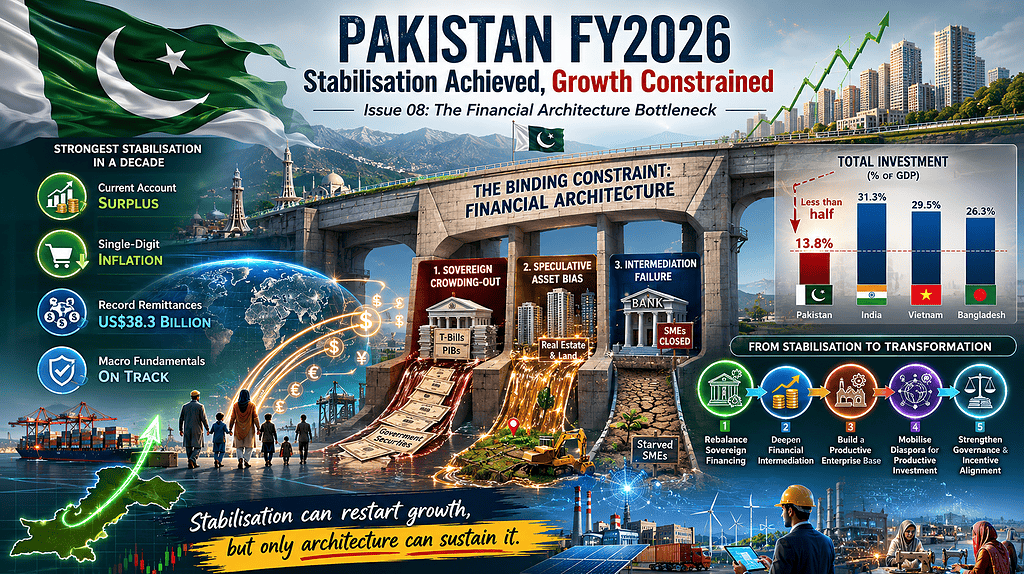
Pakistan has become one of the world's most experienced practitioners of macroeconomic stabilisation. Since its first arrangement in 1958, the country has spent 34 of the subsequent 65 years inside an IMF programme. Each cycle follows a familiar arc: reserves decline, the currency comes under pressure, emergency measures restore balance, and confidence briefly returns. The machinery of stabilisation works. What never follows is transformation.
Fiscal year 2024-25 displays this paradox in its purest form — the strongest stabilisation indicators in years, set against total investment of just 13.8 percent of GDP and private sector credit that has collapsed from 29 percent of GDP in 2008 to under 14 percent today. The question this record poses is not why capital is scarce, but why available capital so consistently fails to reach production.
The answer lies in the architecture. The economy generates very large financial flows — record remittances, expanding deposits, recurring official inflows — yet channels them overwhelmingly into sovereign paper, land, and consumption. That is not a failure of policy calibration; it is a property of the system through which savings, credit, and foreign inflows are allocated. Until the architecture itself is redesigned, each stabilisation will remain what every previous one has been: a pause between crises rather than a platform for growth.
Pakistan enters FY2026 with its strongest stabilisation indicators in a decade — a current account surplus, single-digit inflation, and record remittances of US$38.3 billion — yet total investment sits at just 13.8 percent of GDP, less than half the level sustained by India, Vietnam, and Bangladesh. Issue 08 argues that the binding constraint on growth is no longer macroeconomic management but financial architecture: the institutional and incentive structure that routes the country’s savings, credit, and diaspora inflows into sovereign paper and land rather than productive enterprise. The brief diagnoses three converging structural failures — sovereign crowding-out of private credit, a speculative asset bias in the savings structure, and an intermediation failure that starves small and medium enterprises — and sets out five sequenced reforms to convert stabilisation into transformation. As the financial counterpart to Issue 05’s delivery architecture, it makes a single decisive case: stabilisation can restart growth, but only architecture can sustain it.
Mohey-ud-din, G. (2026). Stabilisation Without Transformation: Pakistan’s Capital Misallocation Trap. Policy Insights by Dr. Ghulam Mohey-ud-din, No. 008/2026. DOI: https://doi.org/10.13140/RG.2.2.24550.38720