Pakistan National Poverty Line: What the Rs 8,484 Figure Really Tells Us
A single number recently set Pakistani social media alight. The claim that the government considers anyone earning more than Rs 8,484 a month “not poor” drew outrage, ridicule, and a flood of memes. Yet almost everything about the way the figure was presented was wrong. Issue 09 of Policy Insights takes Pakistan’s national poverty line apart and puts it back together, tracing its history, methodology, governance, and the reform it now urgently needs.
Key figures at a glance
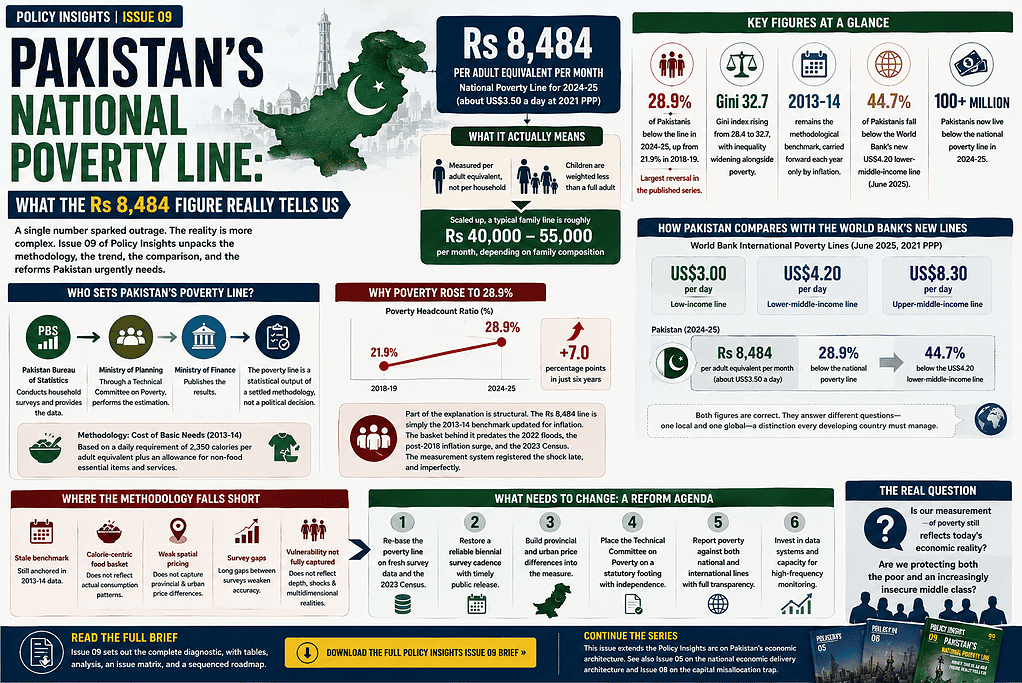
- Rs 8,484 per adult equivalent per month, the national poverty line for 2024-25 (about US$3.50 a day at 2021 PPP).
- 28.9% of Pakistanis below the line in 2024-25, up from 21.9% in 2018-19, the largest reversal in the published series.
- Gini index rising from 28.4 to 32.7, with inequality widening alongside poverty.
- 2013-14 remains the methodological benchmark, carried forward each year only by inflation.
- 44.7% of Pakistanis fall below the World Bank’s new US$4.20 lower-middle-income line (June 2025).
What the Rs 8,484 figure actually is
The number comes from the Pakistan Economic Survey 2024-25, not from any minister’s opinion. It is a statistical threshold measured per adult equivalent, not per household, with children weighted as less than a full adult. Scaled up, the line for a typical family works out to roughly Rs 40,000 to 55,000 a month, depending on its composition. The viral framing turned a per-person measure into a per-household one, and a routine statistic into a political claim.
Who sets Pakistan’s poverty line?
Contrary to the controversy, the Prime Minister does not fix the line. The Pakistan Bureau of Statistics runs the household surveys and supplies the data. The Ministry of Planning, through a Technical Committee on Poverty, performs the estimation. The Ministry of Finance merely publishes the result. The figure is the output of a settled methodology, the Cost of Basic Needs approach adopted in 2013-14, anchored on a daily requirement of 2,350 calories per adult equivalent plus an allowance for non-food essentials.
Why poverty rose to 28.9 percent
The real story was not the number but the trend. Poverty climbed seven percentage points in six years, and well over 100 million Pakistanis now live below the line. Part of the explanation is structural. The Rs 8,484 line is simply the 2013-14 benchmark updated for inflation, so the basket behind it predates the 2022 floods, the post-2018 inflation surge, and the 2023 Census. The measurement system registered the shock late, and imperfectly.
How Pakistan national poverty line compares with the World Bank’s new lines
In June 2025 the World Bank raised its international thresholds to US$3.00, US$4.20, and US$8.30 a day (2021 PPP). Pakistan’s national line sits below the US$4.20 lower-middle-income standard, which is why 44.7% of Pakistanis count as poor on that yardstick against 28.9% nationally. Both figures are correct. They answer different questions, one local and one global, a distinction that almost every developing country, from India to Indonesia, has to manage.
Where the methodology falls short, and what should change
Pakistan’s framework is internationally mainstream, but it has been allowed to age. The brief identifies a cluster of weaknesses, including a stale 2013-14 benchmark, a calorie-centric food basket, weak spatial pricing, and widening survey gaps. The reform agenda follows directly. Re-base the line on fresh survey data and the 2023 Census, restore a reliable biennial survey cadence, build provincial and urban price differences into the measure, place the Technical Committee on a statutory footing, and report poverty against both national and international lines with full transparency.
The real question, then, is not why the Prime Minister “set” the figure at Rs 8,484. It is whether our measurement of poverty still reflects today’s economic reality, and whether policy is protecting both the poor and an increasingly insecure middle class.
Read the full brief: Issue 09 sets out the complete diagnostic, with tables, an issue analysis matrix, and a sequenced implementation roadmap. Download the full Policy Insights Issue 09 brief »
Continue the series: This issue extends the Policy Insights arc on Pakistan’s economic architecture. See also Issue 05 on the national economic delivery architecture and Issue 08 on the capital misallocation trap.