Urbanization without Productivity: Understanding Pakistan’s Missing Structural Transformation
Pakistan’s urban population has expanded from approximately 33 percent in 2000 to 38 percent today — yet this demographic shift has not translated into the productivity gains historically associated with urbanization in developing economies. Cities have grown physically without deepening economically. Labour has been absorbed into low-productivity informal services rather than export-oriented manufacturing. Over 72 percent of non-agricultural urban employment remains informal, constraining fiscal capacity and technological upgrading (PBS LFS, 2025). Manufacturing’s GDP contribution has stagnated at 11.80 percent (FY2024-25), well below the 20–25 percent typical of successfully industrialising economies. Pakistan’s urban transition has occurred without industrial transformation — creating a self-reinforcing cycle of informality, import dependency, and external vulnerability.
Why Pakistan’s Urbanization Has Failed to Generate Structural Transformation
Standard economic theory predicts that urbanization drives productivity through agglomeration economies: labour market pooling, knowledge spillovers, and access to specialised inputs. Pakistan’s urban experience defies this expectation. Cities are growing, but manufacturing is not scaling, exports are not diversifying, and formal employment is not deepening. This disconnection between urbanization and productivity defines Pakistan’s missing structural transformation.
The data underlines the severity of the gap. Manufacturing contributes only 11.80 percent of GDP against a regional comparator benchmark of 20–25 percent. Export intensity — merchandise exports as a share of GDP — remains below 12 percent, compared to 20–30 percent in comparable Asian economies at similar development stages. The informal economy absorbs the majority of urban labour, suppressing productivity, constraining tax collection, and perpetuating household income vulnerability.
Three Structural Gaps Driving Urbanization Without Productivity
This policy brief by Dr. Ghulam Mohey-ud-din identifies three structural gaps that explain why Pakistan’s urbanization has failed to trigger industrial transformation:
1. Fragmented Industrial Geography
Pakistan’s industrial base is geographically concentrated in Karachi and Lahore, with minimal industrial development in second-tier cities or emerging urban corridors. This fragmentation prevents agglomeration spillovers from radiating across the urban system. Provincial capitals absorb infrastructure investment, while mid-tier cities lack the industrial density to achieve self-reinforcing growth dynamics.
2. Governance Fragmentation in Urban-Industrial Policy
The institutional architecture governing urban economic development in Pakistan is fragmented across federal ministries, provincial governments, development authorities, and regulatory agencies with overlapping mandates and misaligned incentives. No single institutional mechanism ensures coherent urban industrial policy — zoning, infrastructure, skills development, and export promotion are planned and implemented in silos that prevent integrated spatial economic strategy.
3. Labour Absorption Without Skill Deepening
Urban labour markets are absorbing the demographic dividend, but without skill deepening. The education-to-employment transition in Pakistan does not equip workers with the competencies demanded by manufacturing exporters or modern services firms. Vocational training systems are disconnected from actual industrial demand. The result is a large urban workforce with low human capital productivity — capable of filling informal service roles but unable to anchor a productivity-driven structural transformation.
Five Targeted Reforms to Drive Urban Productivity
The brief advances five evidence-based reforms to connect Pakistan’s urbanization to structural transformation:
Formulate a National Urban Industrial Policy that explicitly links urbanization planning to industrial location strategy, designating second-tier cities as industrial growth nodes with targeted infrastructure investment. Establish a Metropolitan Economic Zones Framework enabling cities to function as integrated economic units with aligned zoning, infrastructure, and regulatory frameworks. Implement Demand-Led Vocational Reform restructuring NAVTTC and provincial TVET systems around sectoral employer demand and export sector skill requirements. Deploy Urban Productivity Metrics — a standardised city-level economic performance dashboard tracking value-added per worker, formal employment ratios, and export participation rates. Invest in Agglomeration Infrastructure in emerging urban corridors, prioritising logistics connectivity, industrial parks, and digital infrastructure rather than exclusively concentrating in saturated primary cities.
The Core Argument: Urban Growth Without Economic Deepening Is Unsustainable
Pakistan’s urban transition is generating demographic pressure without productivity returns. A growing urban population concentrated in informal employment, without the manufacturing base, export capacity, or fiscal resources to sustain it, represents a structural vulnerability rather than an economic opportunity. The reforms proposed in this brief are not optional enhancements to existing strategy — they are the minimum institutional investment required to convert Pakistan’s urbanization dividend into sustainable structural transformation.
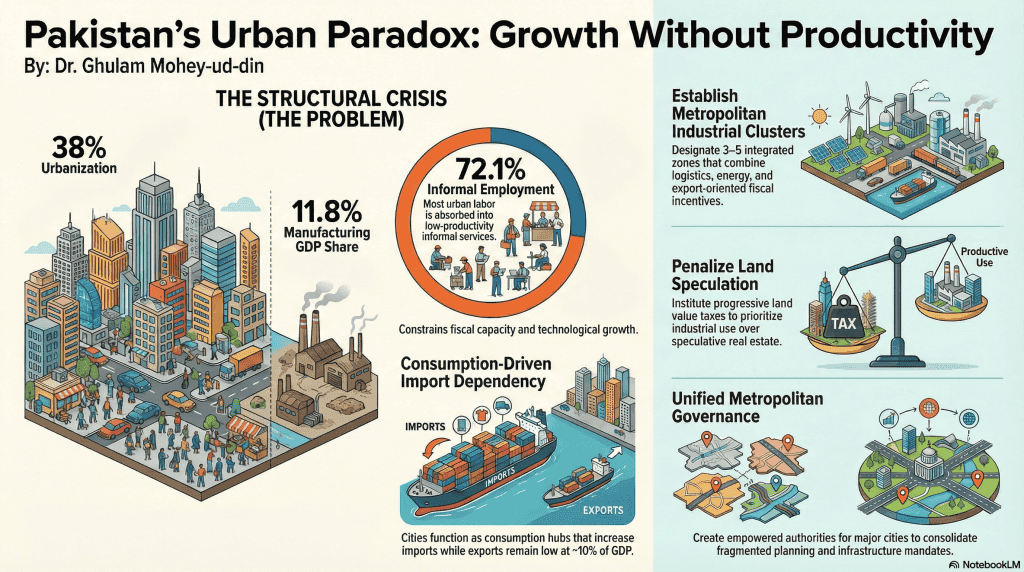
Non-technical summary published as opinion piece @ Minute Mirror
Policy Insights | Issue No. 01 | January 2026 | Urban Economics & Industrial Policy | Dr. Ghulam Mohey-ud-din, Senior Economist & Policy Advisor